
Green Hydrogen: Geothermal’s Route to Pseudo-Commoditization
Date
Image

While it is certainly true that technology is advancing rapidly that targets one, or both, of these barriers by enabling deeper drilling, lower temperature resource utilization, closed loops and enhanced geothermal systems, there is one critical and unchangeable fact: geothermal energy is not a commodity.
One cannot ship a barrel of hot water around the world for consumption, as we do with fossil fuels. Of course, geothermal power can be generated and transmitted over long distances, or in some rare cases, such as Iceland, the hot water piped directly over long distances for heating. But in both cases, there are losses that still restrict the economic utilization of a geothermal resource to being a regional source of renewable energy.
Enter Green Hydrogen
In recent times, governments and industries alike have recognized the incredible potential that hydrogen can play in global decarbonization, especially in the context of transportation fuel. In this vision, green hydrogen is the apex, as it is defined as hydrogen produced using renewable energy through electrolysis. Most think that solar, wind, and hydro are the renewable power source behind green hydrogen. However, the real golden ticket is baseload geothermal power.
The advantage of geothermal power generation is that it runs full time and is not impacted by whether or not the sun is shining or wind is blowing; it provides consistent, baseload power output capability that makes it a perfect energy provider for green hydrogen facilities that operate in the same manner.
Geothermal and green hydrogen designated as a system is a symbiotic relationship with incredible advantages that only come when they are paired together; baseload power supply maintains hydrogen production 24 hours a day, surface footprint is minimized, and government subsidies can be stacked to enable development. Since green hydrogen can be transported or stored for later use, it is the method that enables the pseudo-commoditization of geothermal energy.
There are many remote locations around the world, and especially in the Pacific Rim “Ring of Fire,” where vast geothermal resources exist but with small local populations, and therefore limited need to utilize these resources to its full potential or have a means to fund the development. However, coupling this with green hydrogen, there is now a new model emerging that greatly increases the attractiveness of geothermal in remote areas.
Geothermal Industry Takes Notice
This is not going unnoticed by the industry as well: the recent Halcyon Project in New Zealand has just been finished, which is a green hydrogen plant powered by local geothermal power. Other projects like Meager Creek Development Corporation in British Columbia are in planning, but there are also some extremely visionary organizations like Fortescue Future Industries who are laser-focused on bringing green hydrogen to the world and relying on massive amounts of geothermal energy to enable it.
Now that the possibilities of enabling a pseudo-commoditization of geothermal with green hydrogen are taking shape, how is the other primary challenge of development cost covered with this partnership? While there is government policy being implemented in many countries financing and supporting the development of green hydrogen, I’ll focus just on the USA as an example. The new Infrastructure and Jobs Act (IIJA) created an Office of Clean Energy Demonstrations, with a budget of about $21.5 billion dollars, designated to meet a set of 10 goals. While geothermal energy is not mentioned specifically, it can easily be interpreted that several areas of the funding could go to geothermal developments to help meet the greater goals.
Of that $21.5 billion budget, the largest portion, $8 billion, is designed for “Regional clean hydrogen hubs,” which is inclusive of the producers, consumers and infrastructure needed to build out the network. The Office has the goal of developing at least four hubs in different regions of the U.S., with at least one being a green hydrogen facility. (The others are blue hydrogen, fueled by splitting natural gas into hydrogen and CO2.)
Of course, there are massive power requirements for green hydrogen generation facilities and networks of this size, and it is interpreted that this funding would be inclusive of the power source required. The actual footprint of how a network would look is beyond my area of expertise, but it seems reasonable to think that there would be a mix of centralized/direct power sources; Centralized geothermal power plants for hydrogen generation and compression facilities, and then decentralized facilities (such as H2 fueling stations) that would purchase the renewable energy from the grid, or simply be powered by hydrogen-fueled generators on-site.
Geothermal and Green Hydrogen a Synergistic Pairing
Many questions still exist. For example, if a geothermal power plant is built 50 miles from a green hydrogen generation facility, is it considered a part of the hydrogen hub and therefore qualify for funding? However, it is expected the criteria and structure is something that will become clearer as we move though 2022. It seems highly plausible that portions of this $8 billion will become available to geothermal developers and lease holders such as Fervo Energy, Cyrq and Ormat. They have a huge potential to benefit from this, as does the industry as a whole.
Geothermal has always had to struggle to gain visibility for the funding needed to expand development. But with an incredible amount of funding going into green hydrogen, “piggybacking” into this area opens doors for a high volume of geothermal development in more geographically diverse regions.
The green hydrogen industry and geothermal industry have an enormous degree of synergy to offer each other and are better together. A goal of unification, both in terms of joint project development and global policy creation, should be established by leaders of both industries to take full advantage of the opportunities at hand and better foster the energy transition.
The thoughts and opinions in this essay are mine and not those of my employer.
For all the of the many reasons, possibilities and opportunities that have led me to dedicate my career to geothermal energy, as a pragmatist, there is also a clear recognition of the primary challenges to holding the concept back from a rapid global embrace: geographic limitations and development cost.
College Students Team Up To Design Real-Life Geothermal Concepts
Date
Image

Real-World Renewable Energy Design Experience
In the competition, student teams assume the role of a geothermal developer, devising direct-use strategies to heat and cool buildings, campuses, or districts. The competition fosters project development, design, and communications skills while boosting public understanding of geothermal power as a direct, renewable source of energy. Team submissions include a use case, resource assessment, usage evaluation, and a plan to engage the local community.
The recently completed Spring 2021 round of the competition included geothermal concepts designed for Native American reservations, universities, mixed-use communities, and hospital campuses.
Image
Industry Expert Webinars and Trainings
Student competitors can also participate in a series of virtual trainings on geothermal site planning tools and practices. Upcoming trainings include the GEOPHIRES geothermal techno-economic simulation tool, environmental regulations and permitting for geothermal projects, the GeoRePORT Socio-Economic Assessment Tool, and reservoir modeling tips and tricks.
National Recognition and Cash Prizes
Winners and finalists will be recognized in a live Department of Energy announcement and press release as well as National Renewable Energy Laboratory (NREL) news stories. The competition also includes $50,000 in cash prizes to student teams and their universities.
First, second, and third-place winners will also plan and host live, on-site events to educate relevant stakeholders about their proposed projects during the summer of 2022.
Quote
This study was one of the most rewarding experiences of my academic endeavors.
Attribution
Nicholas Fry, team captain, University of North Dakota Geothermal Vision
Sign Up, Spread the Word to a Colleague, or Become a Judge!
Ready to heat up spring 2022? Sign up, create a team, and upload the first required phase of your submission by Feb. 17, 2022. If you know of an educator or students who might be interested, help NREL spread the word.
NREL competition administrators are also looking for members of the geothermal industry to serve as competition judges. To volunteer as a judge, reviewing student submissions and providing valuable feedback, email geo.competition@nrel.gov.
Are you a university student or faculty member looking for a renewable-energy-focused capstone project for the spring semester? Dig into the U.S. Department of Energy Geothermal Collegiate Competition, which is accepting submissions until Feb. 17, 2022, to win $50,000 in cash prizes.
Tech Talk -- Drilling for Geothermal: Opportunities for Technology Cross-Pollination
Description
This talk will explore opportunities for technology cross-pollination, with a focus on exploration and development drilling. Presented by Danny Rehg, Co-Founder and Managing Partner of Criterion Energy Partners (CEP).
The talk will be held at 1:00 PM CDT on 12/16/2021.
The talk will be held at 1:00 PM CDT on 12/16/2021.
Location
Online
Date
Topics
Image
2022 Geothermal Rising Conference (GRC)
Description
The 2022 Geothermal Rising Conference (GRC) will be held August 28-31, 2022 at the Peppermill Resort Spa Casino in Reno, Nevada.
Engage with your geothermal colleagues and take part in the largest annual gathering of the geothermal community.
Engage with your geothermal colleagues and take part in the largest annual gathering of the geothermal community.
Location
Peppermill Resort Spa Casino in Reno, Nevada, USA
Date
Topics
Featured Image
Image

GRC Event Microsite Launched
Check here for the latest updates on the 2022 Geothermal Rising Conference: https://grc2022.mygeoenergynow.org/
Get Your Booth Now!
Be sure to secure the booth location you want -- download the exhibitor application today!
Technical Program Timeline
*Tentative and Subject to Change
Call for Sessions and Chairs Deadline - December 3, 2021
Call for Abstracts - December 15, 2021 thru January 31, 2022
Abstract Review - February 1, 2022 thru March 1, 2022
Final Confirmation of Accepted Abstracts and Invitation to Submit Papers and Posters - March 2, 2022 thru March 9, 2022
Draft Technical Papers Deadline - April 25, 2022
Technical Paper Review - April 26, 2022 thru May 16, 2022
Final Papers Due - May 31, 2022
Draft Posters Deadline - June 15, 2022
Posters Review - June 15, 2022 thru June 30, 2022
Author Final Withdrawal Deadline - June 30, 2022
Final Posters Deadline - July 22, 2022
Registration Information
For information on registering for the 2022 Geothermal Rising Conference, please go here.
For any questions regarding the 2022 Geothermal Rising Conference, contact: registration@geothermal.org.
Unlock the Elephant and a Clean Energy Future Awaits
Date
Image

Forget what you may have heard about geothermal. Remove the vision of beautiful people in steamy swimming pools and spas, or scenic landscapes of volcanoes and geysers. The Earth energy we need to unlock is everywhere beneath you. This ubiquitous and constant energy is below your home, your workplace, and below you right now as you read this article. Our human senses in our regular daily lives simply don’t see that energy, and we don’t feel it. That energy is always there, flowing up from deep below the rocky crust we inhabit, from our Earth’s very core. It’s been that way for four and a half billion years and will continue for as long as the Earth exists, no matter what our human capabilities do to it.
Image

Caption
Clydeside, Glasgow, location of COP26, and with Earth energy directly beneath it.
The beauty in this energy elephant is that it can be unlocked in a multitude of different ways. It’s energy that can power our needs through electricity generation or by using it directly for both heating and cooling. It can bring equity and be equitable. It can be used for our transport and our homes, or grow our food and provide for our essential needs to survive. Earth energy is truly an elephant among its peers! And then there’s the cage. The technologies have been decades in development as it takes ingenuity, effort, and patience to tame. This elephant has also been locked away from us because the energy market conditions have not led to the support and investment that it deserves. Now is the time to unlock it.
Whether you know it or not, whether you like it or not, we need a renewable and clean energy future. Our society must become carbon neutral as soon as possible. Climate change is an international emergency that is already affecting human civilization and it isn’t going to be good. We need to minimize those climate affects as much as possible, which means kicking the habit from fossil fuels. It means changing the way we live our lives from our petrol fueled cars through to piping natural gas into our homes and industries. It means bringing greater electrification and heat management. Sorry to bring you this bad news, but your propane barbecue will eventually become obsolete!
Image
Caption
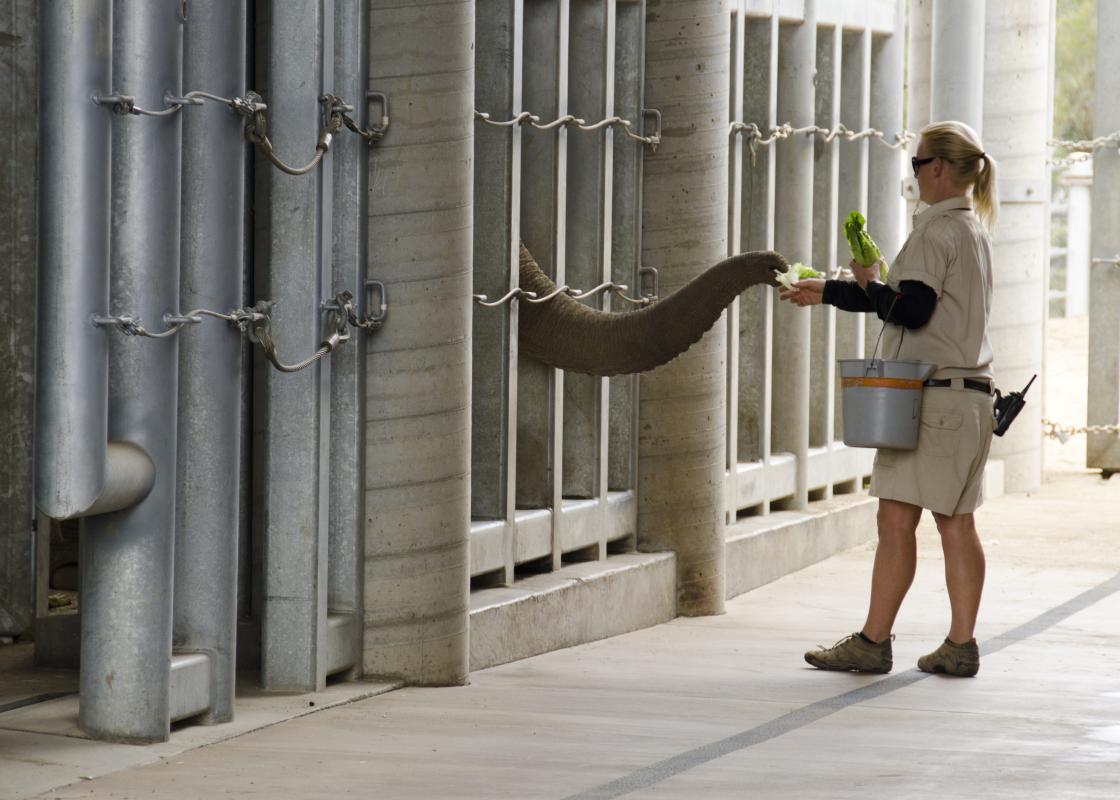
#UsetheEarthtoSavetheEarth – it’s time to unlock this energy elephant!
Our renewable and clean energy future needs electricity generation from solar and wind sources. It needs us to use hydroelectricity and tidal energy. It needs us to change our habits to a more efficient way to use our energy and it needs us to learn how to store energy when we have it available and don’t immediately use it. But it also needs something big, very big! We need an energy source that is always on, no matter the time of day, or day of the year, or what the weather is doing. There needs to be a constant flow of clean and renewable energy that we can use instead of the traditional and polluting baseload power sources like coal, gas, or nuclear.
The reason we need to unlock this elephant is because of what I will refer to as the California Renewables Syndrome. The California Renewables Syndrome is not some form of entertaining spy thriller! It is the inability to transition California to a future of high intermittent renewables without an adaptable always-on energy source that can meet our basic energy needs at any time and any place. Without that ubiquitous source, our clean energy vision is stranded and our quest for decarbonization is beyond reach. California is leading the way in building out intermittent renewable energy and should be applauded, but it’s now reached a tipping point of diminishing returns. It can’t simply transition its power system; instead, it needs to be transformational in its entire energy use. As with many things we now use in our lives, from Google to smoked salmon pizza, the world needs to look to California for taking the lead.
Image
Caption
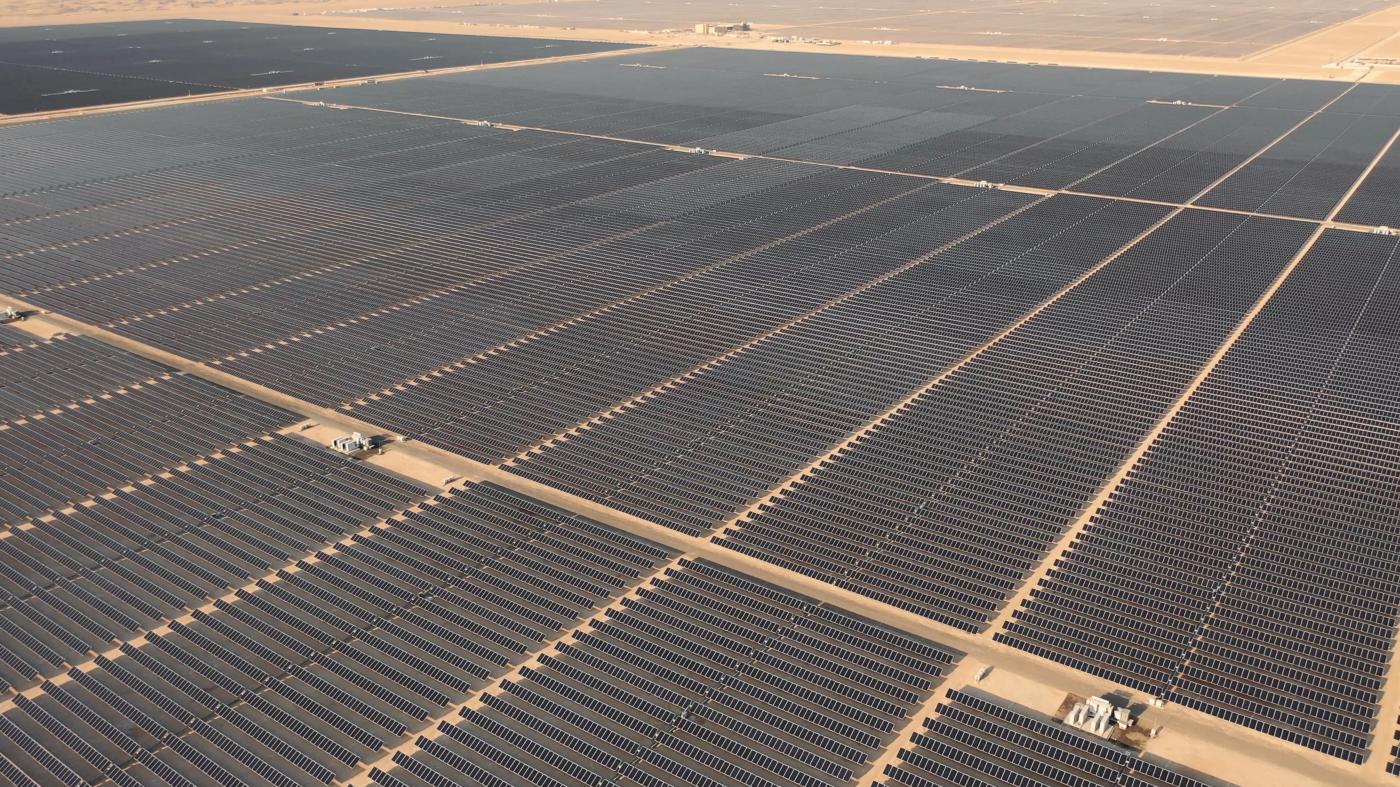
California Renewables Syndrome – Continuing to build out intermittent renewables is unsustainable without unlocking the always-on, ubiquitous, clean and renewable energy elephant beneath us.
The California Renewables Syndrome is caused because wind and solar can’t provide electricity all the time and aren’t effective everywhere. These energy sources are not secure, reliable, or resilient. The California State government has discovered they need to install nearly five times the solar and wind capacity to replace each unit of traditional baseload capacity, just to have enough energy in the system when the intermittent sources are switched on in regular conditions, and that’s in a State that’s conducive to these sources. On a good day, they’ve discovered that when intermittent sources are running well there is too much energy, and on a bad day, when they become unavailable due to some adverse conditions, then there is way too little energy. In between the daily times of feast and famine, daytime and nighttime, there is a need for huge acceleration of electricity onto the power grid from something else. Energy storage can help to smooth out short term supplies, but as wind and solar projects continue to be built out then that amount of energy demand in just a few hours becomes increasingly challenging.
To make things even worse for our clean energy vision, California is feeling this syndrome without a solution to longer-term seasonal demands that will occur with electrification as we reduce reliance on fossil fuels. These seasonal demands will work against the efficiency of solar, when electricity needs increase during cooler temperatures and longer winter nights. And California doesn’t experience the collective heating and cooling challenges that are far more serious in other regions of the planet. Globally, these needs alone contribute over half of all emitted greenhouse gases. The California Renewables Syndrome means that without a big renewable and clean energy source filling the hole then a continuing reliance on polluting baseload is needed or else the lights, and the electric vehicle chargers, will switch off.
And so the elephant in its cage enters the room! People in California are also very lucky because the elephant there can be unlocked with reasonable ease. It happens that the State is the international heart of the geothermal power industry with readily available resources that can be developed with today’s technologies. The California State government has finally handed over the keys to the cage by demanding the power industry procure more geothermal energy to come to its aid. New technologies, entrepreneurs, and startups are now entering the market, and are following research programs funded by the State and Federal governments. And with greater innovation and increasing efficiency then that ability to unlock earth energy at large scales will broaden out to all regions of the globe.
Image

Caption
The US East Coast is an excellent opportunity for unlocking geothermal energy for heating and cooling buildings and using heat in heavy industry.
As our delegates at COP26 convene in the halls of the Scottish Event Campus over the coming days they will debate the greatest challenge to our civilization that we’ve ever faced. How many of them know they are walking and sitting on the solution to their problems? Like the sun shining in the sky, the Earth in its own way is shining beneath them. Many of them probably don’t even realize the issues faced in California and instead call for an ever-increasing use of intermittent renewables that can only partly satisfy our long-term needs for clean power and heat, will not get society to carbon neutral, and will not give us the decarbonized lives we need. So, unlock the elephant in the room, point to your feet, and shout it out, “Earth energy will save our Earth”.
As the international community gathers for COP26 in Glasgow, The United Nations Climate Change Conference, the elephant in the room is energy from the Earth and that elephant is locked in a cage! Unlock that energy and we have a clean energy future, but without it that future is an unrealizable dream. The Earth’s energy beneath your feet is what scientists have called geothermal and it’s big!
In Memoriam: Charles Goetting
Date
Image

We regret to announce Charles “Les” Goetting, passed away Sunday September 12th in the comfort of his home in Ventura, CA after a long battle with Leukemia.
Les founded Project Engineering in 1983 and built PE into the premier supplier of casing accessories and completion tools that it is today. Over the past five years as his health declined, Les retired and hand selected a team of trusted individuals to carry Project Engineering forward. The PE Team is saddened about Les’ passing as he was not just a boss, but a friend, a mentor and father figure. He was greatly loved and will be missed by all who knew him. We would like to thank everyone who kept Les in their prayers and thoughts.
The funeral service date and time will be announced in the days to come.
Per Les’ wishes, in lieu of flowers or gifts, donations can be made to St. Jude Children’s Research Hospital on his behalf.
Any Cards or letters can be sent to the Project Engineering office at:
12611 South Enos Lane
Bakersfield, CA 93311
How Can We Save 2-Trillion Gallons of Water?
Date
Image

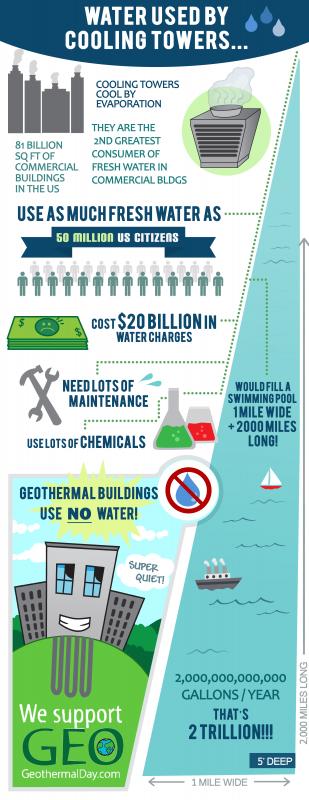
Many commercial and residential complexes use cooling towers to effectively aid in cooling. An average public high school’s* cooling tower uses about 30,000 gallons of fresh water per day when it’s hot outside. That’s enough to fill a good sized back-yard swimming pool. Twice.
A major airport can consume close to a million gallons of fresh water on a hot summer day, just for cooling tower operations. It’s great that we are honoring watering restrictions, fixing drips in faucets and leaky toilet valves; however there are billions of gallons of fresh water being evaporated and discharged into the sewer from cooling towers every day.
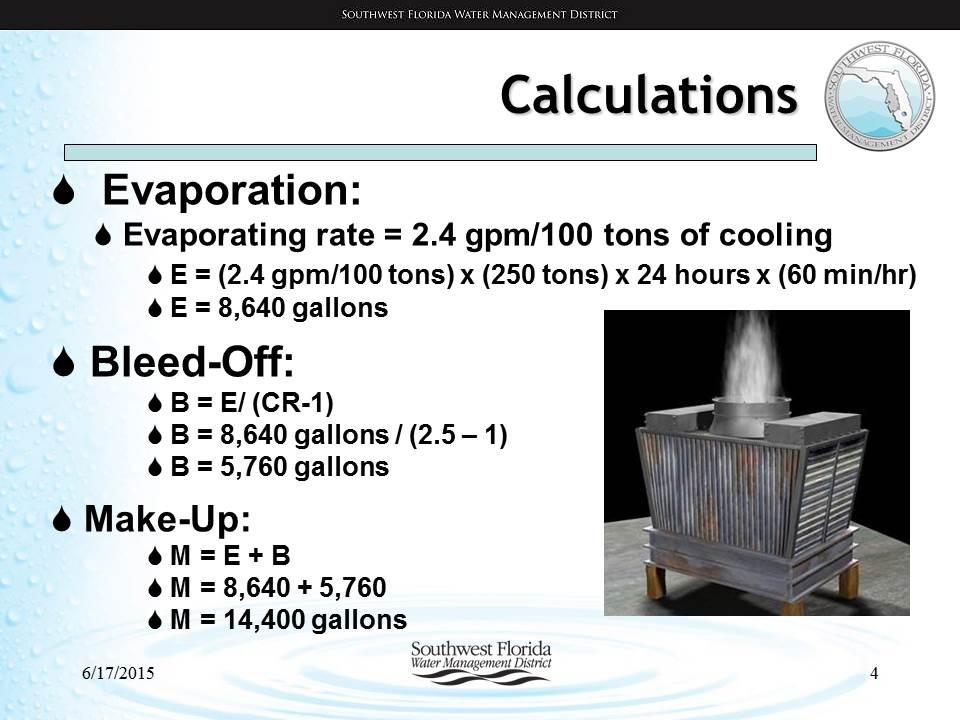
Cooling towers use the process of evaporative cooling to increase the energy efficiency of the air-conditioning equipment that serves the building. In the process, a lot of water is evaporated, and nearly as much more is flushed down the drain to purge out impurities.
The US had about 81 billion square feet of commercial space in 2010, served by 300 million tons of cooling capacity (based on floor space estimates from DOE report). This represents between 5-billion and 15-billion gallons of fresh water consumption each day.
Image
Buildings + Geothermal = More Fresh Water for US!
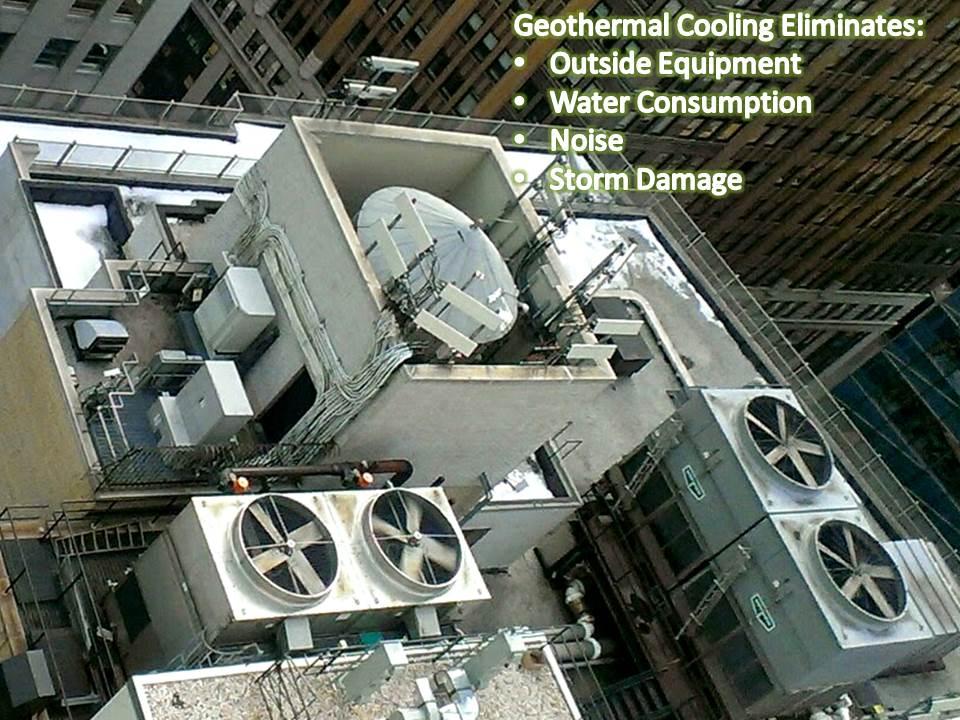
Industry has begun to embrace geothermal (elimination of cooling towers) for all the right reasons:
- Elimination of water consumption associated with cooling towers
- Elimination of tower related noise
- Elimination of chemical treatment for cooling towers
- Reduction in annual maintenance costs for HVAC system
- Storm proofing through elimination of outdoor equipment (the cooling tower)
- Impressive federal tax incentives
- Reduced capital expenditures for regular cooling tower replacement
The advantages that can be cited that make a geothermal sourced building more sustainable are many. With a reduction of water consumption (which can be close to half of all the freshwater consumed by a building), your client is saving money and doing a good thing for the environment.
Cooling towers can be rather noisy, and most will agree that elimination of this outside noise would be of benefit to both the public and occupants of the building.
Image
Geothermal is Renewable and Energy Efficient, Too
Geothermal sourced chiller plants and heat pumps are more efficient by design, because the condenser water is cooler than can be supplied from an evaporative cooling tower, increasing the EER (Energy Efficiency Rating) substantially.
The average life of a chiller is about three decades, and most chiller plants live through two or three cooling tower replacements. With the geothermal source, these expensive planned expenses go away.
By placing a chiller plant, or any cooling tower-sourced building using water source air-conditioners/heat pumps on a geothermal source, you have created an entirely geothermal sourced building, making the entire building’s HVAC system eligible for federal tax credits. This means that when upgrading chillers and water sourced heat pump, they may be eligible for the current tax credits for geothermal systems.
Most regions of the country and the world have storm events periodically such as hurricanes, tornadoes, blizzards, etc. These storm related events can destroy outside equipment. Many insurance companies will provide credits for elimination of this equipment. The New York Times said, “Geothermal Systems Arise as a Storm-Proof Resource”. Additionally, outside equipment often needs to be winterized, and properly installed geothermal sources may save you these seasonal costs and headaches.
The federal government gives a 10% federal tax credit, and five year depreciation through the Maximum Accelerated Cost Reduction System (MACRS) on commercial geothermal systems. With 50% bonus depreciation the first year, a $1 million upgrade can net federal tax incentives amounting to 48% of the entire cost, or federal tax incentives of $480,000.
Image
A Helping Hand for the California Drought (and everywhere else)
The USGS says that the average American uses 80 to 100 gallons of water each day. Cooling towers use as much fresh water as 50,000,000 US residents each day. I think that California could put that water to good use. This is in the neighborhood of 20% of the volume of water that flows over Niagara Falls each day (65 Billion gallons of water flow over Niagara Falls each day).
*based on national average of 752 students per high school, 2000 https://nces.ed.gov/pubs2001/overview/table05.asp
You'd be surprised how much water...