
High-Power Turbines for the Next Wave of Binary Geothermal

Binary plants based on the Organic Rankine Cycle use a closed organic working fluid to extract heat from geothermal brine and then reject that heat through air-cooled or water-cooled condensers. As unit sizes increase, designers raise the mass flow of the working fluid to move more heat through the cycle.
At the turbine, that choice appears as a volumetric-flow problem. Large plants can push flow at outlet conditions to levels that require a single radial outflow machine to have very wide passages, large casings, and long blades. When dimensions grow this way, efficiency and mechanical robustness become harder to maintain.
Many plants solve the problem by splitting the flow into two parallel turbines. That approach works, but each additional machine adds foundations, piping, valves, auxiliaries, and maintenance tasks. For large developments built from repeated modules, the extra complexity compounds.
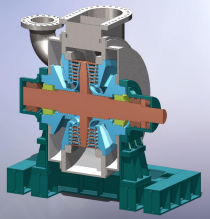
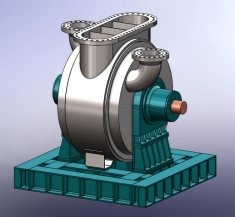
Exergy’s Gemini turbine concept retains the radial-outflow architecture but divides the flow path within a single body rather than using multiple separate machines.
The working fluid enters from two symmetric inlets. Each side feeds a mirrored set of stages mounted on a common rotor disk. The flow expands radially outward on both sides, then turns and exits toward a central exhaust. The rotor sits between bearings rather than in an overhung configuration, which improves stiffness and rotor dynamics for a machine of this size.
This layout roughly doubles the volumetric-flow capacity of a single turbine frame while targeting turbine isentropic efficiency above 90 percent. Instead of two smaller turbines, a plant can run one dual-flow machine on a single shaft, keeping the rest of the power island comparatively simple.
Exergy’s technical paper for the Geothermal Rising Conference uses a 50 megawatt binary plant as a reference case. The study represents a medium-enthalpy enhanced geothermal system with high brine flow and air cooling.
Brine enters the heat-exchange train at around 200 degrees Celsius and leaves at around 96 degrees before reinjection. Flow is on the order of 2,000 metric tons per hour. The working fluid is commercial n-butane, preheated and vaporized in shell-and-tube exchangers and slightly superheated before entering the turbine.
In this model, the Gemini turbine expands the working fluid through six stages and delivers slightly above 50 megawatts of mechanical power at the shaft. Gross electrical output at the generator sits around 50 megawatts, with net output just over 40 megawatts after auxiliary loads. Cycle efficiencies fall in the expected high-teens to low-twenties range for this temperature window.
An induced-draft air-cooled condenser closes the loop, allowing operation in areas where cooling water is constrained and keeping the geothermal fluid in a closed circuit from production to reinjection. The study team performed one-dimensional sizing, computational fluid dynamics simulations of the flow paths, and structural and rotor-dynamic checks. CFD results matched preliminary design values within a few percent. Stress and vibration analyses showed comfortable margins against yield and resonance for the modeled operating envelope.
Exergy’s current geothermal fleet already includes large binary units operating across different environments. The Gemini concept extends that family into higher-flow ranges, but the company’s installed base illustrates how binary technology is being used today.
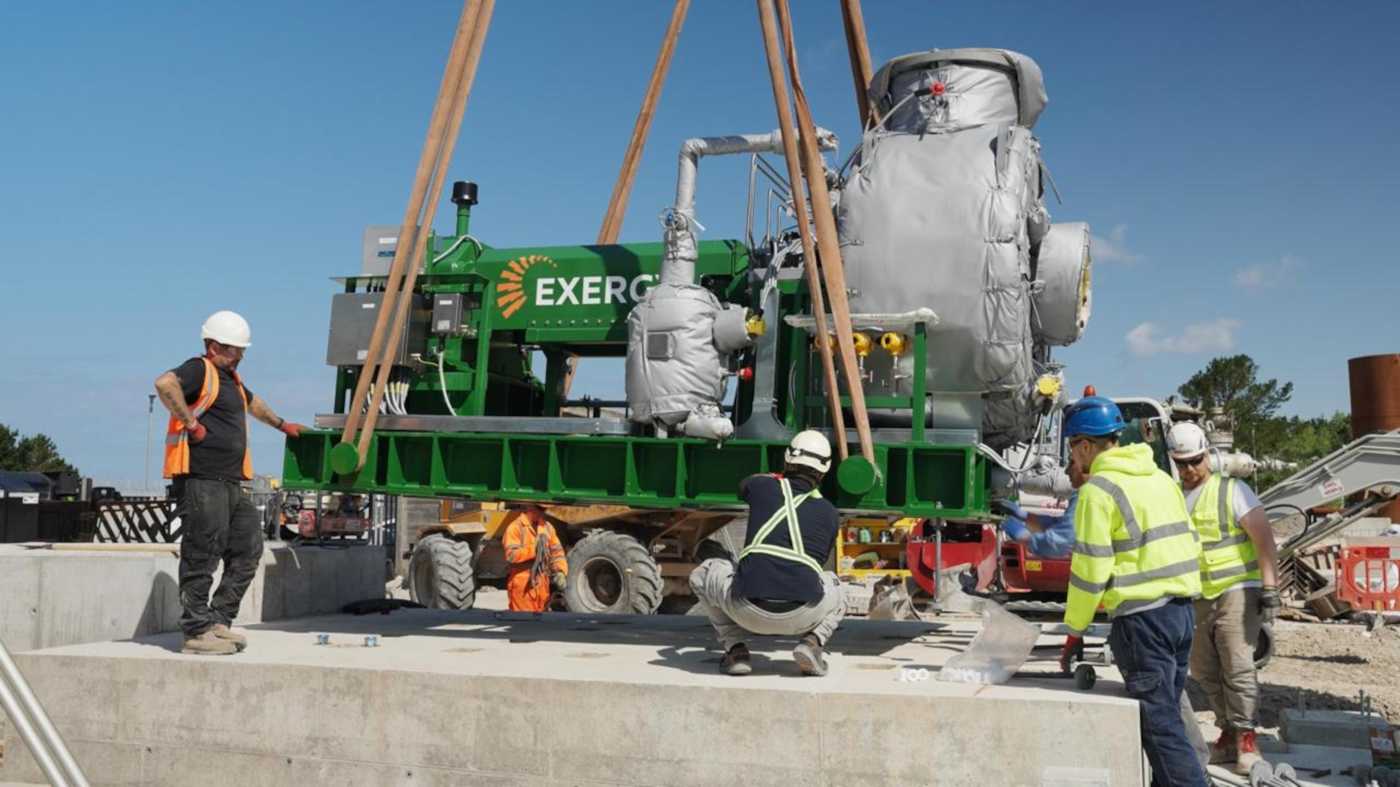
uses a binary plant to generate electricity and support lithium-extraction
operations from deep geothermal fluids.
At United Downs in the United Kingdom, a binary unit provides power from a deep well in Cornwall while also supporting a lithium extraction process using the produced fluids. The facility sits close to residential and industrial areas, so the surface plant must remain compact and quiet while delivering firm power from a new resource.
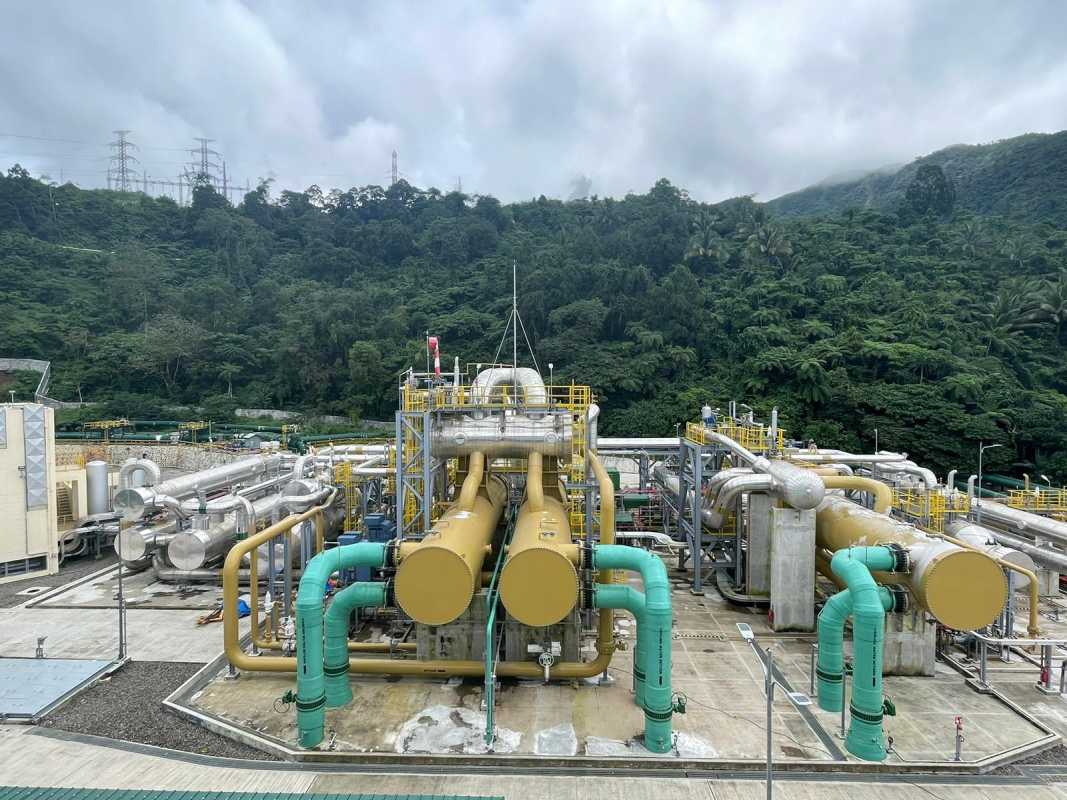
generation from lower-temperature brine at an existing geothermal field.
In the Philippines, a 24 megawatt binary unit at Mahanagdong uses lower-temperature brine from an established field to add generation without new high-enthalpy production. The plant operates in steep, forested terrain with heavy rainfall, which makes a compact, integrated power island valuable. Both projects use Exergy’s existing radial outflow turbines rather than the
new dual-flow design, yet they highlight a common theme. Binary systems are increasingly installed as flexible building blocks that work alongside existing fields, industrial processes, and new mineral-recovery schemes.
Enhanced and advanced geothermal systems often target medium-enthalpy resources with high volumetric flow. Wells can be directionally drilled, stimulated, or configured as closed loops to create heat-exchange areas in rock that would not flow naturally. Surface systems must convert that steady flow into reliable power at competitive cost.
Binary plants already form the backbone of many of these concepts. The main question is how individual units can scale up without adding unnecessary complexity. High-flow radial outflow turbines provide one answer. A single dual-flow machine that can handle the working-fluid volume of a 50 to 60 megawatt module allows designers to:
- Keep turbine layouts simple while increasing unit size.
- Reduce the number of foundations, valves, and auxiliaries per module.
- Maintain strong efficiency in a flow regime that would otherwise require multiple machines.
For developers and operators, turbine design becomes a front-end choice along with well architecture and brine chemistry. Matching turbine configuration to flow and temperature is part of de-risking large projects before the first well is drilled.
Large binary geothermal units demand turbine designs that can manage very high volumetric flows while staying efficient and mechanically robust. Dual-flow radial outflow machines, such as Exergy’s Gemini concept, show that it is possible to increase unit size without multiplying the number of turbines.
As enhanced and advanced geothermal projects grow, success will depend on both the engineered reservoir underground and the power-conversion hardware at the surface. High-flow turbines are becoming a key part of that surface toolkit, turning more of the available heat into dependable megawatts while maintaining practical layouts for construction and operation.