
Breaking the Depth Barrier with Millimeter-Wave Drilling and the First Superhot Geothermal Power Plant
Conventional geothermal development typically reaches depths of about two kilometers and temperatures around 200°C. At those conditions, wells produce useful heat and power, but output per well remains modest relative to the thermal resource below. Enhanced geothermal systems have begun pushing into hotter, tighter formations, yet the fundamental constraint remains: rotating drill bits, motors, and downhole electronics degrade rapidly as temperatures climb past 200–250°C.
The result is an industry that contributes less than one percent of global electricity despite sitting atop a resource that dwarfs demand. The U.S. Department of Energy has set a target to increase geothermal power production twenty-fold by 2035 through EGS. Even that ambitious goal only begins to close the gap between what is technically accessible today and what exists at depth.
The deeper and hotter you go, the physics improve: higher enthalpy fluids, greater density contrasts between injection and production, and more efficient power conversion at the surface. What has been missing is a drilling system that can survive and perform economically under those conditions.
Millimeter-wave drilling originated in decades of gyrotron research at MIT, where high-power microwave sources were developed for plasma heating in fusion reactors. Quaise adapted that science into a drilling system: a surface-based gyrotron generates concentrated millimeter-wave energy, which is transmitted down a waveguide to the rock face with minimal energy loss.
At the bottom of the hole, the directed energy ablates rock through thermal spallation and vaporization rather than mechanical grinding. No rotating bit contacts the formation. Because the energy source sits at the surface, it is not exposed to downhole temperatures or pressures. Cuttings are removed by a pressurized purge gas system rather than heavy drilling mud, eliminating many of the circulation challenges that plague deep conventional wells.
The system has already penetrated more than 100 meters through granite in field conditions, proving the approach works in the crystalline basement lithologies where superhot rock is found. That milestone moved the technology from laboratory demonstration to field validation.
Depth isn’t an advantage; the superhot resource is.
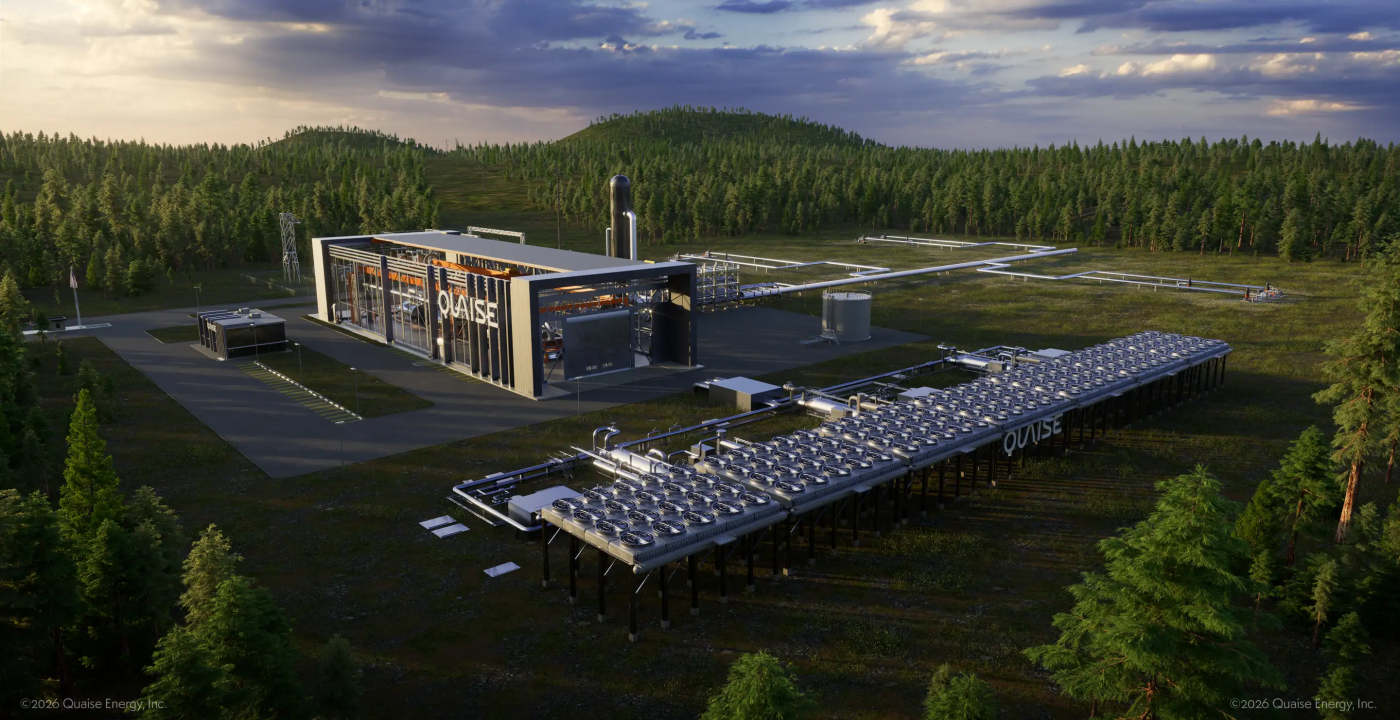
Project Obsidian, located in Central Oregon, will be the first commercial deployment of millimeter-wave drilling and the world's first superhot geothermal power plant designed from the outset to operate at 300–500°C.
The development follows a phased approach:
Phase I delivers 50 MW through a combination of conventional drilling for upper well sections and millimeter-wave drilling to reach superhot depths. Phase II expands the facility to 250 MW by accessing deeper, hotter rock below the initial wells, reaching temperatures up to approximately 450°C. Phase III targets 1+ GW as the site and technology mature.
The site was chosen as the best-studied, most economically viable location in the United States to prove superhot geothermal at scale. Quaise has secured land leases and commercial offtake agreements, with first power targeted by 2030.
Surface facilities will use high-efficiency turbines operating at the highest available capacity factors for geothermal, delivering firm baseload power with zero fuel, zero waste, and zero emissions. The compact footprint means less land disturbance per megawatt than any other thermal generation technology.
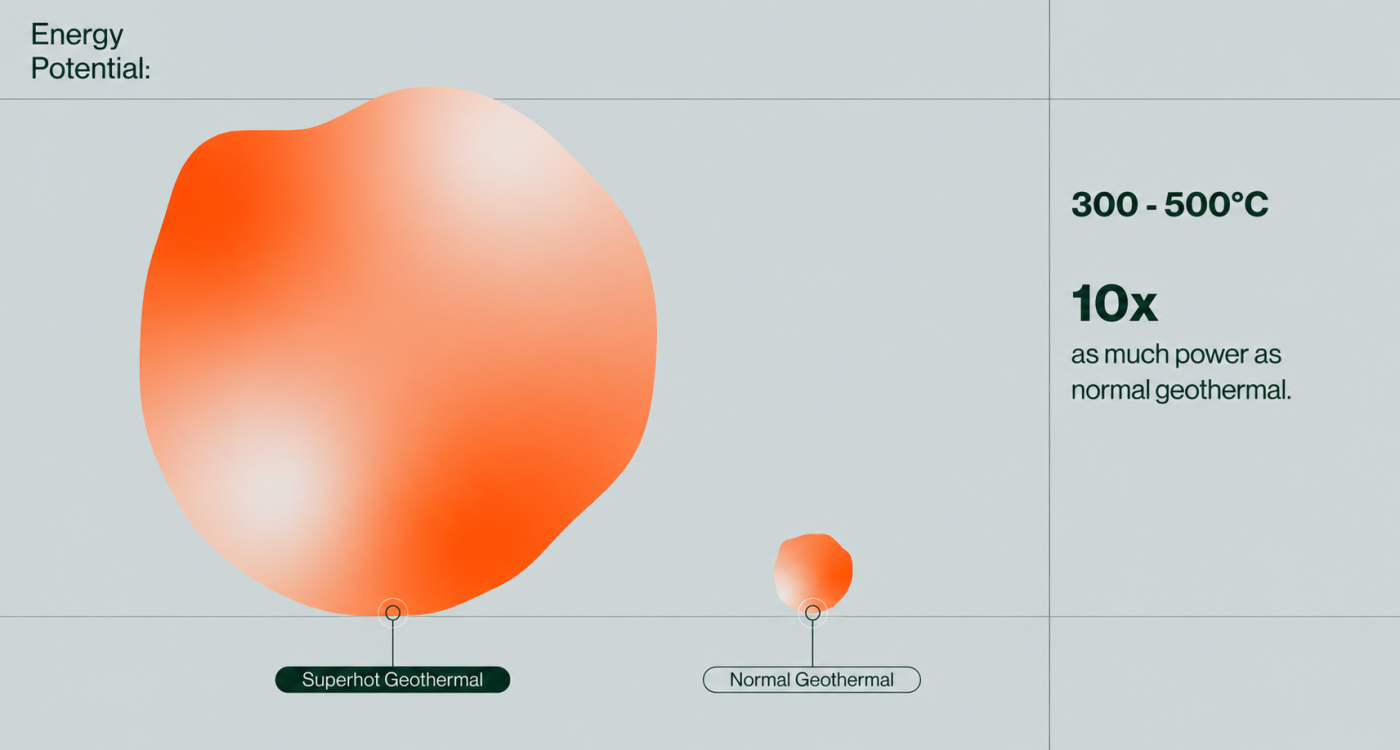
At 300–500°C, water enters a supercritical or near-supercritical state with properties that transform well productivity. The working fluid exhibits gas-like viscosities (enabling easy flow through engineered fracture networks), liquid-like densities (maximizing heat transport per unit volume), and extreme density contrasts between injection and production wells (minimizing parasitic pumping loads).
The combined effect is 5–10 times as much electricity per well as conventional geothermal, and potentially up to 100 times as much as low-temperature systems. Higher temperatures also mean higher Carnot efficiency in the turbine, so a greater fraction of the extracted heat is converted to electricity.
Crucially, the geochemistry in a superhot engineered reservoir is controlled rather than inherited. Water chemistry is managed to prevent scaling and corrosion, sustaining decades of peak heat transfer. Working in deeper, tighter formations also reduces water losses compared to shallower fractured systems.
Project Obsidian is designed as a proof point, not an endpoint. Quaise's tiered development roadmap starts in areas with the highest geothermal gradients (Tier I sites such as Central Oregon), then scales to Tier II and Tier III locations where superhot rock occurs at greater depths. Millimeter-wave drilling's independence from downhole temperature makes those deeper targets accessible without an exponential cost escalation.
The long-term implication is geographic: superhot geothermal could expand east of the Cascadia volcanic arc, east of the Mississippi, and beyond the global Ring of Fire, potentially bringing firm clean power within reach of more than 90 percent of the world's population. That is a fundamentally different value proposition than conventional geothermal's dependence on rare volcanic hotspots.
Quaise is also investing in regional partnerships, including collaboration with Oregon State University's Experimental Deep Geothermal Energy (EDGE) lab, to characterize subsurface conditions common to superhot systems and build a knowledge base that benefits the broader industry.
The transition from mechanical to directed-energy drilling represents more than an incremental improvement. It removes the temperature ceiling that has defined geothermal's scale for decades. Project Obsidian will test whether that removal translates into the economic and operational advantages predicted by the physics.
Three implications for the wider community:
- Superhot conditions improve every variable that matters: power per well, conversion efficiency, land intensity, and long-run cost. If the physics hold at commercial scale, geothermal competes directly with fossil baseload on economics, not just emissions.
- Drilling technology is the bottleneck, not the resource. The thermal energy below three kilometers is effectively unlimited. Systems that can reach it affordably redefine geothermal from a geography-constrained niche to a universal energy source.
- First-mover projects like Obsidian will generate operational data that the entire industry needs. Performance data from superhot wells, millimeter-wave penetration rates, and long-term reservoir behavior at supercritical conditions will inform EGS design worldwide.
If Project Obsidian delivers on its phased targets, the geothermal industry's conversation shifts from how to expand incrementally to how fast it can scale.