
The Overlooked Variable in EGS Success
Enhanced geothermal systems deliver firm, always-on power by turning hot, low-permeability rock into a controlled heat exchanger. Instead of tapping a rare natural hydrothermal reservoir, developers create permeability through stimulation, then circulate water through the engineered fracture network.
In that model, it is imperative that the system is built to last. The fractures and their ability to stay open and conductive become the heart of the asset. If the fracture network closes or degrades, the well’s productivity falls. If it remains open and conductive for decades, the same capital investment can support decades of baseload energy.
That is why the quality of the engineered reservoir “system” is an overlooked variable in EGS success. It determines not only how the well performs in the first few years, but also how it behaves over twenty or thirty years of thermal cycling and flow.
For CARBO, this is where the company’s role starts. CARBO positions itself not as a commodity supplier, but as a subsurface technology partner focused on the performance and longevity of the engineered reservoir.
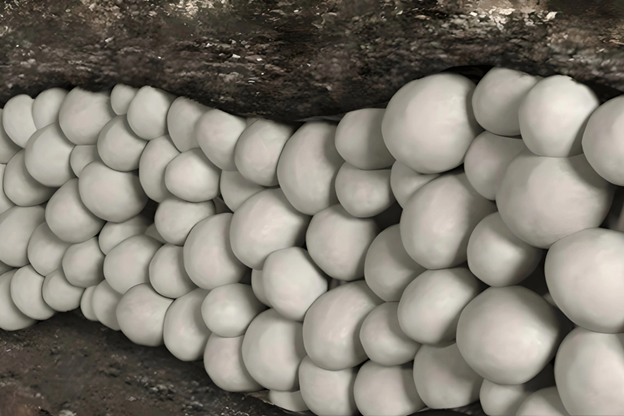
Within an EGS reservoir, proppant often looks like a detail. It is not as visible as the drilling rig or the stimulation pumps. Yet it plays a decisive role. Proppant grains keep fractures open once pressure is released. They are the skeleton and ultimately the backbone of the heat exchanger.
If the proppant crushes, dissolves, or migrates, fractures close, and effective flow paths can narrow or even cease to exist. That leads to higher pressure drop, lower flow rates, and a shrinking thermal sweep. In economic terms, it shortens the productive life of the well.
More importantly, in an EGS development, the propped fracture network is not just a subsurface detail. It is a direct extension of the power plant infrastructure. The efficiency and long-term output of the surface facility are fundamentally tied to the reservoir’s ability to deliver consistent, high-conductivity flow over time. If conductivity degrades, the plant does not operate at its design capacity. If it is preserved, the entire system, from reservoir to turbine, performs as intended for decades.
Several factors make EGS more demanding than typical oil and gas environments:
- Temperatures can reach 300°C or higher in some advanced EGS and superhot rock concepts.
- Closure stresses can be high as the rock responds to stimulation and thermal cycling.
- Geothermal brines can be chemically aggressive, with scaling and corrosion tendencies.
Conventional silica sand was never designed for that combination. Under high temperature and stress, sand will crush into fines, partially dissolve in hot fluids, or chemically react in ways that narrow or block flow paths. Research on proppant reactivity in EGS environments has highlighted that long-term fracture conductivity can decline sharply when proppant is mismatched to the reservoir conditions.
By contrast, high-performance ceramic proppants are engineered from the start for strength, thermal stability, and chemical resistance. CARBO’s geothermal line, for example, is built specifically for EGS and other extreme subsurface environments. Products like GEOPROP and GEOPROP MAX are designed to withstand high temperatures, high closure stresses, and aggressive brines while maintaining conductivity and mechanical integrity.
The core idea is simple: if proppant is the skeleton of the engineered heat exchanger, then proppant selection is a strategic design decision, not a line-item commodity.
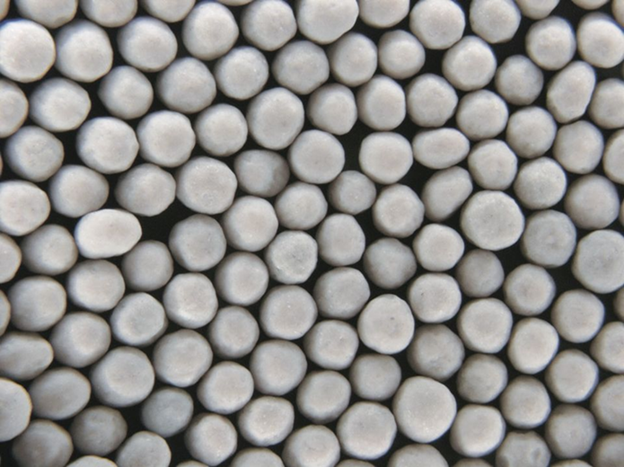
Ceramic proppants bring several characteristics that are directly relevant to enhanced geothermal systems:
- Strength under stress. Engineered ceramic grains are manufactured to high, consistent strength, so they resist crushing under elevated closure and thermal stress cycles.
- Thermal stability. Ceramic proppants such as GEOPROPare fired at temperatures above 1500°C. That thermal history helps them retain structure and conductivity in geothermal reservoirs where formation temperatures can exceed 300°C.
- Chemical durability. Ceramic compositions and patented pelletization techniques can be refined to resist dissolution and chemical attack in geothermal brines, reducing fines generation and preserving flow paths over time.
- Optimized conductivity. Uniform grain size and shape help create higher-conductivity packs, reducing tortuosity and pressure drop across the fracture.
For geothermal developers, the economics of these properties are straightforward. EGS wells require high upfront capital for drilling and stimulation. Once that money is spent, there are only two ways to improve returns: increase the heat produced over the life of the project, or extend its productive life. Long-term fracture conductivity serves both goals.
Ceramic proppants are designed to maintain that conductivity under conditions that would quickly degrade sand.
In other words, proppant is directly tied to improving lifecycle economics. Getting it wrong can shorten the reservoir's life. Getting it right can protect the capital invested in the well and support truly infrastructure-grade geothermal assets.
Supply certainty is another, often overlooked, variable in geothermal project risk. EGS developments are capital-intensive and schedule-driven. Delays in critical materials can cascade into rig standby costs, missed grid connection windows, or contract penalties.
CARBO manufactures its ceramic proppant in the United States, building on a forty-five-year manufacturing base in high-quality advanced ceramics. That U.S. footprint provides several advantages for geothermal projects operating on tight timelines:
- No exposure to overseas tariffs on core proppant volumes.
- Shorter and more predictable logistics chains for North American projects.
- The ability to coordinate delivery schedules with drilling and completion programs.
For developers, that supply-chain reliability translates into one less source of uncertainty. It also supports domestic content goals where they apply, which is relevant for projects seeking certain forms of U.S. federal support.
In a market where EGS wells are often drilled in frontier conditions and testing new designs, reducing supply-chain risk around critical materials helps keep attention on the subsurface learning curve, not on whether the next proppant shipment will arrive.
Since 1979, CARBO has built a global business around engineered ceramic solutions for demanding environments: high-pressure completions, complex unconventional reservoirs, industrial processes, and now geothermal.
Over more than four decades, CARBO has:
- Pioneered high-strength ceramic proppants that became widely used in oil and gas for maximizing EUR and return on investment.
- Invested in research and development centers to characterize fracture conductivity, proppant transport, and long-term performance under stress.
- Developed diagnostic and modeling tools that link proppant selection, fracture design, and economic outcomes in complex reservoirs.
In the geothermal space, that experience is now being applied to enhanced geothermal systems and superhot rock concepts, working with developers to design fracture systems that will remain conductive under the thermal, mechanical, and chemical realities of each project.
For Geothermal Rising’s member community, this kind of cross-sector transfer is part of the broader story of how subsurface expertise from oil and gas can accelerate the geothermal learning curve.
The geothermal sector is moving from pilots toward large-scale, infrastructure-grade deployment. EGS and related technologies are central to that transition, and as that shift happens, expectations around asset life and reliability will tighten. Power purchasers, regulators, and investors will question how long a deployment can sustain output. That question leads directly back to the engineered reservoir and to the materials that support it.
Ceramic proppants are not a silver bullet, but they are one part of an integrated EGS design that includes stimulation strategy, well architecture, and thermal management. They are part of what directly touches the “overlooked variable” this article began with: the quality and durability of the fracture network.
By combining advanced ceramic proppant technology, subsurface engineering expertise, and U.S.-based manufacturing, CARBO is uniquely positioned as a solutions-based partner for developers who want to de-risk EGS performance and protect the long-term value of their assets. For investors and operators betting heavily on infrastructure-grade geothermal, the focus on the longevity of the underground heat exchanger is a necessity.
For Geothermal Rising members, the main lesson is simple: in enhanced geothermal systems, fracture network quality is something you design. Proppant selection is a critical component in a successful development.
Treating proppant as a strategic choice rather than a commodity can:
- Improve long-term fracture conductivity and connectivity in extreme temperature and stress environments.
- Support better lifecycle economics by protecting early capital investments.
- Reduce some of the operational and supply-chain risk associated with EGS development.
- Reinforce power plant efficiency and long-term reliability by ensuring the reservoir consistently delivers the flow needed to sustain design capacity and revenue generation.
As enhanced geothermal systems scale up, the operators and developers will be judged not just on drilling deeper or hotter, but on building systems that last. Advanced ceramic proppants, applied thoughtfully and supported by subsurface expertise, are one tool that can help make that longevity real.